
I came to this movie as someone with thanatophobia with an “unusual” burial request. If I die before my partner, I want to be cremated and turned into cremation stones. When he dies I want the stones of my body put inside his chest cavity when he’s embalmed to be buried. If he dies first, if possible I still want this done – him exhumed and me placed or my ashes added to his grave in some other way. I actually have an irrational fear of the very thing that is discussed in the film – that some soul or conscious part of me will linger attached to my body so I want cremation. Whereas my partner prefers the idea of rotting in rest and dislikes the idea of being burned up. (If the idea of being conscious in your dead body freaks you out, check out the movie After.Life (2009) with Christina Ricci and Liam Neeson).
All that said, I knew that this movie would set off my thanatophobia – my anxiety attacks around the inevitability of death specifically. It’s why it took me so long to watch it despite being an avid Cronenberg fan. I knew I would love this movie but needed to be in the right headspace. Finally, I was – well, I was at least in a headspace where I knew it wouldn’t make things worse.
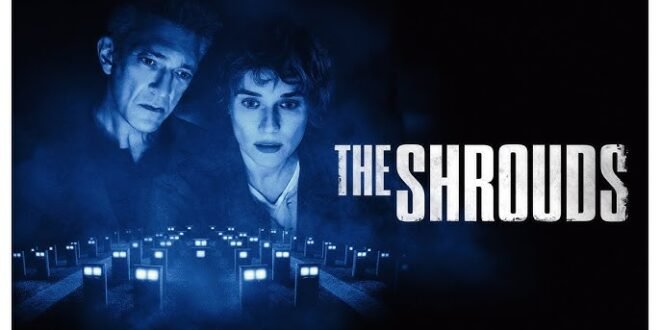
The Intimacy of the Slow Burn
Did I say that Possession was the best slow burn horror movie?
So sorry to report that it now has competition for that crown in The Shrouds. In fact, I think The Shrouds challenges and exceeds Possession in its slow burn qualities and its ambiguity.
We have long scenes where the camera refuses to pan away or cut to the next scene. Uncomfortable sex scenes that are weirdly erotic and disquieting at the same time. Conversations that seem to be unrelated to the situation or plot until later. Long pauses where we sit with Karsh as he processes or plots (depending on your final takeaway of the movie).
If you enjoyed Crimes of the Future, can handle a quiet slow burn, and are comfortable with never having the answers…The Shrouds is an excellent watch.
A Masterclass in Unreliable Narrator
We start off with Karsh as the sympathetic if unhinged mourning husband who cared for and adored his wife in life and death. He is an atheist and therefore has no coping beliefs of reunion with Becca in an afterlife. All he has in the desire to care for her in death as he did in life – and then turned that into a second career.
Later we see Karsh as someone who needs to take care of others. He cared for his wife through her cancer. He attempts to care for Tess by visiting and inquiring about her career. He cares for Maury by feeding him his favorite foods when he enlists him to do work. He positions himself as wanting to care for Soo-min by making a joke about wanting to be her seeing eye dog. He is offended when his AI assistant becomes something cozy and comforting (a koala bear) and not the cartoon version of his late wife and even says she needs rest, something that isn’t possible for an AI, when her loyalty is brought into question rather than simply turning her off all together.
We also see him struggling in attempting to move on with a new apartment, dating, and having sex with other women. However, even in those acts, his wife’s “ghost” lingers and he is often shown crying quietly during intimate moments or waking from sleep where he dreams about Becca.
All of this and indeed the whole movie are told in intimate closeness with Karsh. We rarely escape his focus and point of view. (The few moments where the camera deliberately excludes Karsh, such as a jarring sequence hinting at his past involvement in ambiguous, possibly political or industrial propaganda films. It’s a rare crack in his omnipresent control, suggesting a history he is actively trying to overwrite.) In fact, we never really sit in the presence of other mourners other than his lover Soo-min whose spouse is still alive but dying off screen..and she doesn’t exactly seem to be mourning anyways. Everything and every scene and every person is through Karsh’s lens.
It’s not until near the end we see that the lens is corrupted. First we assume by outsiders manipulating him for their own sick or political purposes. Then…we start to understand…Karsh himself might not be the innocent mourner. He might be the manipulator.
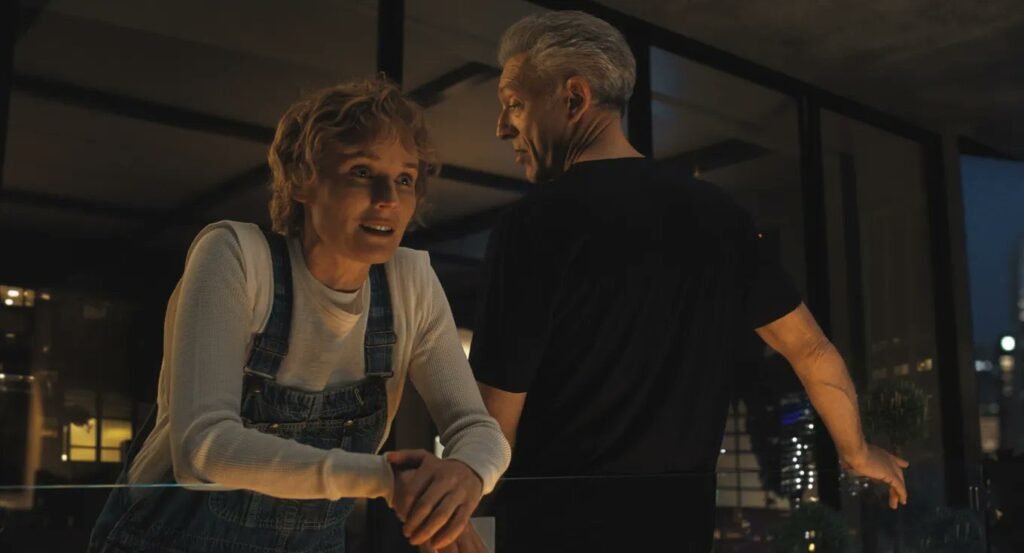
I’m currently trying to lure my best friend, a fan of The Magnus Archives with a crush on Jonah Magnus, into watching The Shrouds by promising a sexy old man with questionable morals.
Let’s be so for real for a second: Cronenberg movies are damn horny, and he directs sexy, morally grey older men better than almost anyone in cinema. Vincent Cassel’s Karsh is a masterclass in this specific, unsettling magnetism. The quiet authority, the intellectual smarm, the way the camera lingers on him even when he’s being deeply unethical. It’s a weaponized aesthetic. This is the Trojan Horse of Cronenberg’s eroticism. We, like Karsh’s partners, are seduced by the competence and the caretaking. The sexiness is the UI that makes the malware palatable. It forces the audience to sit in the dissonance of being aroused by the very power dynamics the film is actively critiquing.
The Xenophobia of Conspiracy
The whole movie is a story of conspiracy theories and the unknown. So it makes sense that Cronenberg would play with Asian xenophobia in our post-Covid world.
We have the obvious – the theories that China’s businesses and government will be using Karsh’s GraveTech company as a surveillance company. Later hackers from China are also brought up as possible antagonists. China’s government as an unknown villain is a common threat and baddie in a lot of conspiracy theories. It’s an easy target today as it was during the Red Scare.
Other micro-aggressions are also present though. Karsh is questioned multiple times about his Japanese zen style apartment that he had designed that way to develop some peace and relaxation. However, it is also a way to distance himself from the traditional western styling of his marital home and life.
Then there is his relationship with Soo-min brought into question. Tess asks if she is Japanese like Karsh’s apartment – dehumanizing Soo-min as decoration out of jealousy or another level of conspiracy. Karsh corrects Tess that Soo-min is half-Korean half-French.
Lastly is Becca’s doctor, Rory Zhao. Maury tries to use the doctor’s nationality as part of his anti-Chinese conspiracies. Karsh however isn’t even aware if the doctor is Chinese.
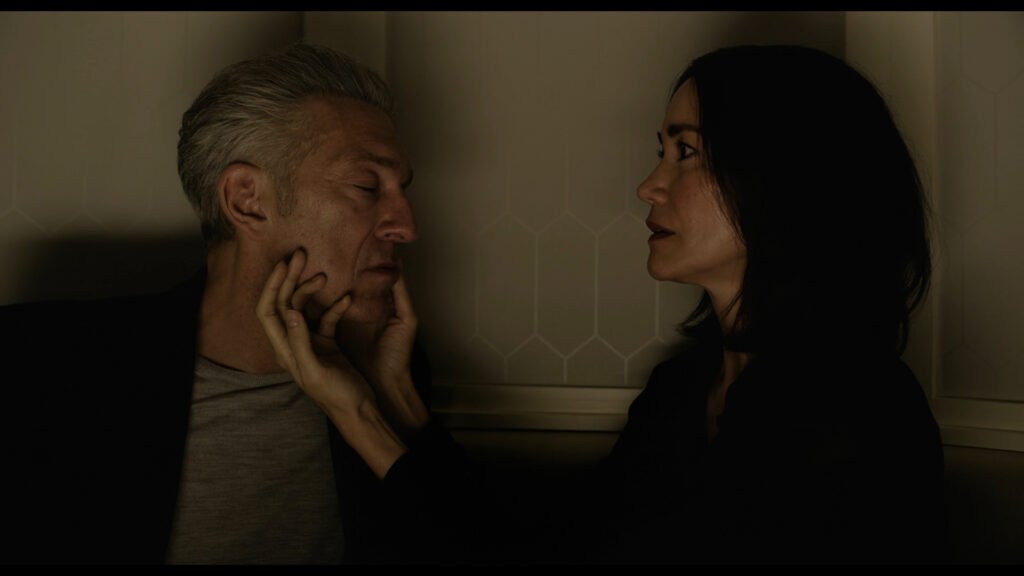
Karsh is continuously presented as “colorblind” about the various ethnicities however even this is a microaggression in and of itself. Karsh doesn’t care about the ethnicity of his allied companies so long as he gets what he needs for GraveTech. He doesn’t care about Soo-min’s ethnicity so long as he gets her husband’s funding and her as his lover that relies on his care. He doesn’t care about Dr. Zhao’s nationality or him as a human beyond a resource for information. He doesn’t care about the historical or cultural background of his Japanese zen apartment beyond that its supposed to help him calm. All of these are commodities to him and his goals.
The fear of the other also includes his being of Eastern European descent without any emotional or familial attachment to that ancestry married to a Jewish woman who might not have been orthodox but was connected enough to her culture to want a traditional burial. He didn’t care about the culture, he did the traditional burial because it fit his narrative and need to care for an control Becca’s existence even in death. Her traditions and culture were simply a convenient excuse. However her benign Jewish with a Aryan-presenting atheist who may or may not have made films for the industrial complex and more…is another layer of the conspiracy theories that are never answered and complicate Karsh as an unreliable narrator.
But Where is the Meat?
If you’re coming to this expecting traditional Cronenberg flesh tearing, mutating, visceral gorey body horror, you might be thrown off. The Shrouds isn’t about the rupture of the body; it’s about the digitization of it. The horror here isn’t in the meat; it’s in the gaze. It’s the psychological dread of watching the physical decay of someone you love reduced to a pixelated, encrypted livestream. The body is no longer a sacred vessel; it’s just hardware, and Karsh and Maury have the admin passwords.
Yes there are scenes where we watch someone decay. We see questionable bone growths. We see someone suffering from bone cancer lose body parts surgically and discuss their commodification for the elevation of a man’s career only for her burial itself used to create the career of a different man.
All of this is body horror which in essence is the loss of bodily autonomy in the most exaggerated ways. But to me this doesn’t slap me in the face because as an AFAB person with health issues…this is just life. Its easy for me to nod and go “of course” and focus on the other parts of this movie because its the horror of living.
Techno Necromancy and The Reality of Death in the 21st Century
Here is the most unsettling trick Cronenberg pulls: We never actually meet Becca. Not once. We only meet her metadata. We see her rotting form rendered through an iPhone screen. We see her in Karsh’s glitching, corrupted dream-logic. We see her reduced to static photographs and skeletal dental X-rays handled like crime scene evidence. We see her in Hunny the AI that uses her voice and appearance in a cartoony way. And then we have Tess, her sister, played by the exact same actress, serving as a fleshy, breathing proxy…a legacy skin Karsh can interact with because she shares the same underlying architecture. Karsh isn’t mourning a woman. He’s desperately trying to compile a ghost out of whatever data he has left.
I came to this movie with my own morbid, romantic blueprint for death: cremation stones placed inside my partner’s chest cavity, a final, physical refusal to let go. The Shrouds didn’t cure my thanatophobia, but it did reframe it. I get that this movie is about conspiracy and the unknown (and what greater unknown and conspiracy than death itself). However I am forever going to be hung up on the act of death and what comes after because no review is objective.
This movie is obviously influenced by the discussions around animating the images, vocalizations, and residual data of the dead into AI facsimiles. Ads for making AI agents from the data of dead loved ones or ancestors or dead celebrities are now part of the surreal landscape we live in.
Cronenberg shows us that trying to manage, curate, or digitally preserve the dead is just a glitchy, manipulative firewall against the void. Whether it’s through a GraveTech app or a literal cavity in the earth, the desire to control the aftermath of death is just that: control. In Heathenry (something the movie alludes to with runes and ravens and other references to Icelandic ecology and ideals) it is said that we are only the stories we leave behind. I just hope that when my time comes, my story remains mine, and not just another dataset for someone else to manage.