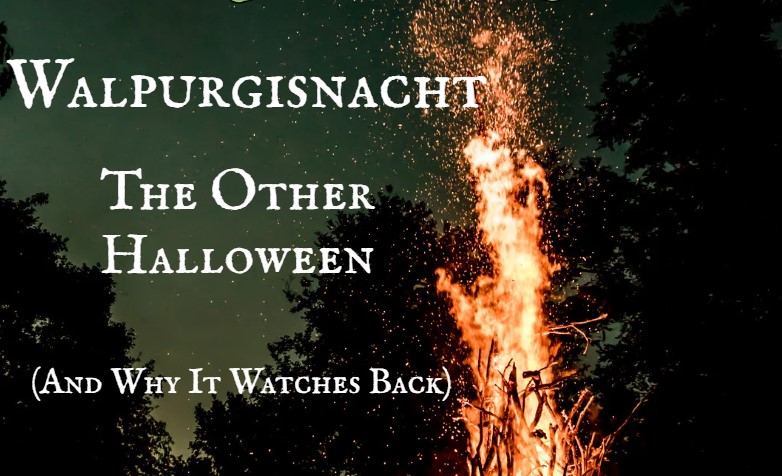

Halloween is the night we expect the stranger but Walpurgisnacht is the night the strange expects us…
Six months opposite of October 31st, on the eve of May Day, something older than costumes and candy stirs beneath flower crowns and festival ribbons. The fires are lit for protection, or, perhaps, an invitation.
Like Halloween, Walpurgisnacht is a threshold or liminal holiday. It is situated between seasons, states of being, and between what is controlled and what is not. Walpurgisnacht has long been associated with witch gatherings, ritual fires, and the thinning of boundaries between the humans and the…otherwise. Unlike Halloween, however, this is not a night that arrives quietly. Where Halloween is about the dead crossing over, Walpurgisnacht is about the living stepping out of bounds.
Historically observed across parts of Northern and Central Europe, Walpurgisnacht was believed to be a night when witches gathered in great numbers (most famously atop Germany’s Brocken mountain). Fires were lit to ward them off. It was the end of the Wild Hunt that stormed through the winter tide and gathered up lost souls and the unwary traveler. It was a time for spirits to return home…sometimes with a human or two in tow.
Walpurgisnacht is a night of protective (or invitation) fires that bleed into May Day. May 1st is a tonal shift from dark warning to flower crowns and ribbons. It is celebrated as a time of renewal and fertility. However, folklore rarely separates celebration from darkness or function. In many traditions, seasonal festivals serve many purposes. May Day is a joyful holiday, for sure, but is that joy spontaneous or required? Does the dance around the maypole celebrate the season or complete a ritual begun the night before?
In many traditions, celebrations of renewal are also acts of appeasement and alignment. A way of ensuring that whatever woke in the that remained…cooperative…contained.
Ritual Viewing
A few folkhorror movies to remind you of the danger and beauty of the holiday…Do not assume that all gatherings are meant for you.
The Wicker Man (1973)
A primary cultural reference for May Day rituals within isolated communities. Highlights the intersection of agriculture, belief and participation…and the consequences of misunderstanding one’s role in the ritual structure…
Midsommar (2019)
A modern exploration of ritual horror in the daylight.
Particularly notable for its depiction of emotional assimilation and the easy with which outsiders can be absorbed into systems and rites they do not fully understand…
Blood on Satan’s Claw (1971)
Examines the relationship between land, seasonality, and corruption.
Suggests that what emerges in spring is not inherently benevolent and that communities should adapt accordingly…
Further Viewing
If you need more suggestions for your ritual please see:
- Häxan (1922)
- Kill List (2011)
- A Field in England (2013)
The Ritual Continues
Halloween asks us what might return? Walpurgisnacht asks what is already here?
If the fires are no longer lit, if the warnings are no longer given…what might come through the thing boundaries? What might take us back with them?
It might be worth asking whether anything has changed at all from the old days and old ways or if we have simply forgotten which parts of the ritual were meant to keep us safe as we don our flower crowns.